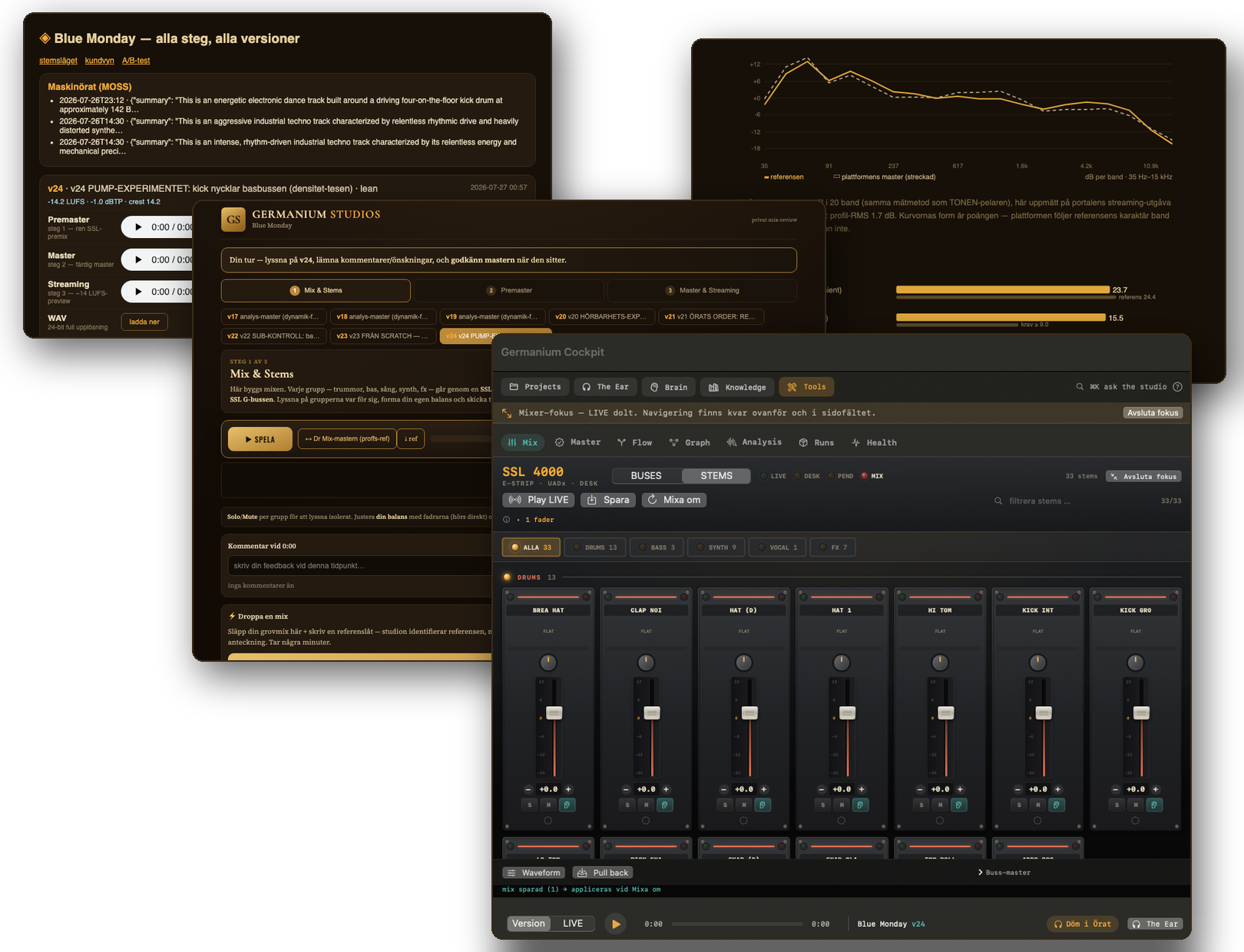
Germanium Studios is a studio operating system for analog mixing and mastering — Neve, SSL, Pultec, Studer — where automation handles everything that isn't music, and professional ears make the decisions. No master leaves the studio until a human has listened and said yes. This portal is where the music is heard, discussed and approved.
Musicians should be able to hear their material in professional shape — mixed and mastered through a true analog signal architecture — without booking a studio for every pass. Stems go in one end; listenable, comparable and traceable versions come out the other: material solid enough to make decisions on, whether the next step is a release mix with an engineer or a release of its own.
The People
The music and the sound are human work. Behind every project stands an engineering team, and it is the team's ears that make the calls. Automation handles everything around the music that isn't music: the measurements, the comparisons, the housekeeping, the logs and the paperwork. It proposes — it never decides. And one thing deserves to be said outright: no artificial intelligence processes the audio. The signal passes exclusively through the studio's analog chains, and the path is deterministic — the same project renders the same master, bit for bit, whenever it is rendered. Automation works with numbers and lists; it never touches the music. Every suggestion — whether from automation, a guest or a colleague — passes the same human review, and the final pillar of certification can only be passed by a human: listening, and saying yes. See a real certification →
The team, not the names
We work as an engineering team and answer as one. Internally, every decision is traced to a person — outwardly, it is the studio's shared ear that speaks.
Four surfaces, one core: the stage view with every version and its measurements, the tone profile against the reference, the listening view where guests comment and approve — and closest, Cockpit: the team's SSL mixer with the ear's verdict one click away.
The Idea — five principles
The ear decides
Measurements are the floor, never the judge. No version is approved by a number — a human who has listened makes the call, and the call is logged.
A clean foundation
Every mix starts in a clean SSL 4000 chain. Character — tape, tubes, iron — is added as deliberate decisions on top, never as layers you have lost count of.
Reference-driven
The mix is measured against real reference masters: spectrum, dynamics, stereo width, loudness. Deviations are information, not automation — they become proposals, never interventions.
The smallest intervention
A correction is easy to add and hard to hear afterwards. So the total amount of processing is measured, and the smallest intervention that solves the problem wins.
Full provenance
Every render is logged: what material, which decisions, which tools, what result. Every master can be explained after the fact — and recreated exactly. See a real render log →
Same master. Every time.
Measured, not promised: two complete renders of the same project produced bit-identical files — the same checksum, byte for byte. The signal path is deterministic; taste is versioned; nothing drifts in the dark. See the proof →
Ask the studio
The studio is not only operated — it converses. Every surface speaks to the same core, so you can ask in plain language, and the studio answers with its own measurements: what a unit is capable of, what a word means in physics, how your track sits against a school's canon. You can set any parameter in the unit's own language — receipt included. The conversation is trustworthy for three reasons: the studio answers with measurements, never opinions; house rules apply in conversation exactly as everywhere else — proposals only, the ear decides; and everyone speaks through the same door.
Set the Fairchild's fourth time constant.
Done. Display reads back: "4" — verified.
What does "warmer" mean on this mix?
Measured across the corpus: sub +1.7 dB · low +0.6 · air +0.6. Listen at 25 / 50 / 100 % — you point.
Which school is this track?
Six ladders rendered against calibrated canons, loudness-matched. The ear chooses.
Features
The Foundation Mix
The material is measured first: hierarchy, balance, masking. Then the mix is built on the clean SSL foundation, bus by bus — automation keeps the order, ears set the direction.
Mastering
Dynamics first — loudness from the music rather than the limiter. Targets are set by the reference and by the reality of streaming: LUFS, true peak, correlation.
The Listening Portal
A/B between versions and against the reference, per-bus solo, a stems mixer for your own balance proposals, time-stamped comments, requests and approvals — on your phone or on screen.
The Drop
Upload a track together with a reference — the platform verifies the reference, builds a master and sets up the A/B comparison with an engineer's note.
Personal views
Everyone involved gets their own link with their projects and their role — listener or producer. Everything you do carries your name; you see what you are part of, nothing else.
The Seal
A finished master is sealed under the Germanium Standard — a runnable six-pillar check where the final word always belongs to a human listening.
Stems and reference are registered to the project. Sources are cleaned gently — DC, subsonics, fake stereo — without touching levels or tone.
Source diagnosis
Before any decision, the material is measured: group hierarchy, source balance, masking. The diagnosis decides what needs doing — and what should be left alone.
Foundation mix
The SSL foundation is built: console pan law, phase, filter hygiene, the buses' analog chains. Character is added as separate, documented decisions.
Listening & requests
The version is published to the portal. Everyone involved listens, compares, comments at timestamps and files requests — the raw material for the next version.
Master
Dynamics-first against the reference's window. Every step gets a measurement receipt; every version can be A/B'd against the last.
Seal & delivery
Once the ear approves, the master is sealed with its full history. Delivered in listening formats and full resolution — with the reference comparison intact. See a sealed certification →
The Signal Path
The whole road from stems to sealed master — with the listening loop back into the console. No shortcut past the gate or the ear.
The Control Room
The Master Section
The Output Bus
stereo · needles follow the music
SSL 4000 G
mix-bus compressor
Manley Massive Passive
tube EQ · master
Studer A800
2-inch tape
Ampex ATR-102
master tape
The Mix
SSL 4000 E
channel strip · the foundation
Neve 1073
preamp · EQ
UA 610
tube preamp
1176 & LA-2A
FET · opto compression
Fairchild 670
vari-mu · never on drums
API 2500
drum bus
The Rooms
Lexicon 224
digital reverb · 1978
EMT 140
plate reverb
Capitol Chambers
echo chambers
Hardware names refer to the modeled originals the platform’s signal chains are built on. Each name belongs to its manufacturer.